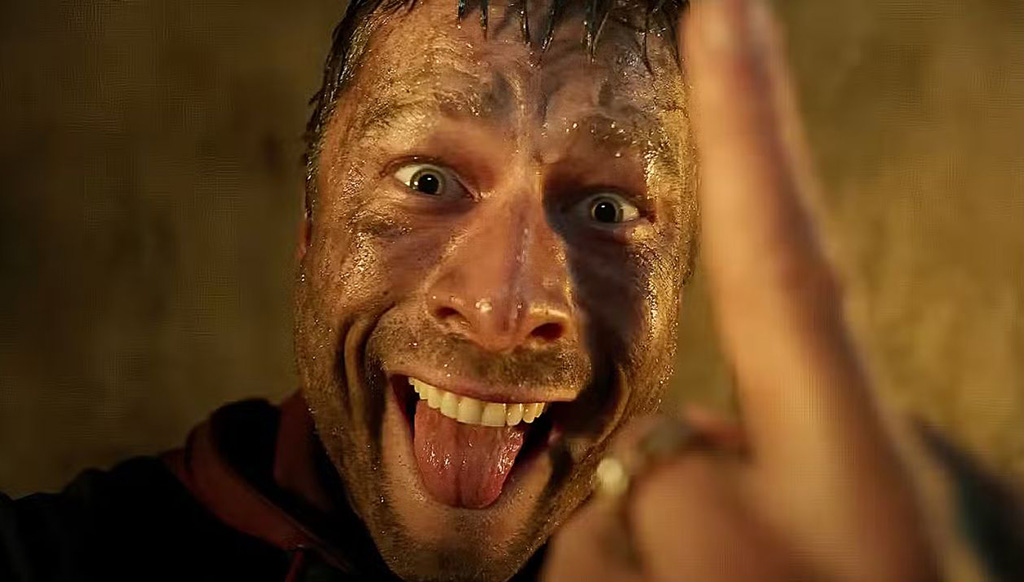
In the Edgar Wright-directed remake of The Running Man, there’s an action scene set to a somewhat obscure pop song I didn’t recognize, because of course there is. I just told you it was an Edgar Wright movie; weren’t you listening?
At the end of the scene (most of which is in the trailers), our protagonists make their way down to a secret passage carved out underneath a house. As soon as they get underground, the music suddenly sounds muffled, as if we’re hearing it as part of the chaos still going on above ground. So the score, which had previously been non-diegetic, was now actually happening in the movie’s world. Or maybe it wasn’t? Or maybe it always was?
That’s exactly the kind of thing that happens pretty often in Edgar Wright movies, but here, it’s not so much a stylistic flourish as it is a reinforcement of the movie’s overall themes. The Running Man is all about details that make you question how much of it is “real,” all with the meta-awareness that none of it is “real,” because it’s a movie. But then, it’s a movie talking about very real and relevant stuff. Or maybe it isn’t? Or maybe it never was?
Earlier in the movie, there’s a scene where Glen Powell’s character is talking to Josh Brolin’s, and in a fit of rage, Powell suddenly and violently slams Brolin’s head onto the desk. But then, much like my favorite moment from 8 1/2, we see that it didn’t actually happen, but was an intrusive thought showing what Powell wanted to do.
Earlier than that, we were introduced to a guy who we know immediately is Comic Relief Guy, because we recognize him from Saturday Night Live. It feels jarring and even a little tone-deaf, since up until that point, the movie had been completely straight-faced in its attempts to present us with a bleak dystopian future, as painfully earnest as any Hunger Games installment. But this guy’s one character trait — as soon as he enters a new space, he immediately declares the most obvious thing that everyone else can see — is actually kind of funny. Later on, we see a presentation from someone who’d been studying the history of The Running Man episodes, who informs us that the comic relief, the hedonistic DGAF type, and the angry “final man” who always survives the longest, are all the stock character types that are cast in every season of the show.
Once I clued into the idea, I was completely on board, and I started to see it everywhere. There are multiple scenes that feel like all is lost for our hero, until they’re revealed to be dream sequences. Cameras are everywhere, and we sometimes see the action switch between the “real” camera and the in-world camera, or even see a scene from multiple camera angles at once.
More subtly: our hero (the unnaturally pretty Glen Powell) has a scar on his forehead in the exact place that manga and anime characters have a bulging vein to indicate that they’re angry, and whenever he gets angry, the scar becomes especially visible. Meanwhile, our villain (the unnaturally pretty Lee Pace) spends most of the movie wearing a full face mask, and when his face is finally revealed, it’s covered with what appears to be burn scarring. Based on everything else, I don’t think it’s at all a reach to take this as commentary on what Hollywood considers beautiful vs “average” looking.1And speaking of shockingly beautiful people presented as if they were average, everyday, working-class folks: in case you spent the whole movie wondering where you recognized the actor who plays Powell’s wife, it’s Jayme Lawson, who played Pearline in Sinners.
Combined with the overt plot points of deep fakes being used to show fabricated versions of scenes we’d already watched, multiple characters acknowledging that everything they do is for show, and over -the-top depictions of our main villain — with weapons named “FATE” or “JUSTICE” in on-screen text that seems to exist both in the movie’s world and not — it all combines to give the constant undercurrent of suspicion, the feeling that you can’t be certain of a single thing that you’re seeing, and nothing that the movie is presenting should be taken at face value.
It felt like an ingenious way to do a modern remake of a movie that was, by all accounts, pretty clumsy and toothless late-1980s satire. It’s now all a meta-commentary on media manipulation, presented by a director who loves meta-commentary, and loves controlling, subverting, and manipulating what we see on screen.
Or maybe it isn’t?
I keep calling this a “remake” instead of a “new adaptation,” even though it is a much more faithful adaptation of the original book, and it’s coming out in the dystopian future year of 2025, when the original book was set. I’ve never seen the first movie in its entirety, only scenes out of context. And I haven’t read the original book, since I’d already lost interest in King’s “bleak future” stories by the time I heard of it.2I still haven’t read The Stand, and that’s the one exception that I have every intention of reading. Someday. But at least based on the synopses — and the inclusion of a picture cameo from Arnold Schwarzenegger on the money used in this movie — this feels like it’s as much a reaction to the earlier movie as an attempt to more accurately adapt a book.
Overall, I got the impression that they were attempting to make the movie that should’ve been made in 1987, more than the one that should’ve come out in 2025. A classic case of satire aiming for where the target is, instead of where the target is going to be.
Because for all the tension that I’d felt building throughout the movie, causing me to get more and more suspicious of everything I was seeing, gearing me up for the other shoe to drop in an explosive reveal… it just doesn’t.
There’s nothing particularly wrong with it, as far as action movies go. It’s fine, and it’s engaging. And especially in an environment of generative AI, its depiction of a society where believable but completely fake images are quick, seamless, and ubiquitous, is a good reminder to be skeptical of everything you’re shown, especially when it gets a strong reaction out of you.
But I’d been expecting a movie that was “subverting the thing while doing the thing,” as Greta Gerwig described her Barbie movie, and that didn’t happen. Which shouldn’t have surprised me, because I already acknowledged that that can’t happen, because it’s impossible. Even if it weren’t in a movie about evil, totalitarian media companies that was distributed by Paramount, a Skydance corporation. A movie like this could not possibly be a genuinely biting satire of contemporary media, because it’s too much a product of contemporary media.
In fact, if you think too hard about it, the satire of The Running Man turns inside-out, and it becomes the worst example of the thing it purports to be satirizing. There’s some amount of this deliberately built into the movie and its premise: it shows blood-thirsty audiences eager to see people getting murdered in increasingly gruesome ways, to an audience that’s watching an action movie in which people get murdered in increasingly gruesome ways.
But it seems more sinister when you consider how much it simplifies the evils of this dystopian society down to a revenge quest against one specific bad guy. And especially when it shows the “common people” becoming victorious thanks to the power of zines and video exposes, as opposed to, say, governmental regulation or outright overthrow of the government. If you think too much about that, it seems less like a satire, and more like a placating fairy tale about resistance.
So it’s best not to think too hard about it! The Running Man is around 30 minutes too long, and it doesn’t really stick the landing well enough to rise above being a competent action movie, but it’s frequently clever, it’s got a lot of imagination, and there’s a fun sense of self-awareness throughout. Which is all interesting, even though it is ultimately more self-awareness of how movies work than about how society works.
In one of the scenes that was highlighted in the trailer and was evidently intended to be an iconic moment, considering that it was included in the “zines” that are shown over the end credits, Richards looks directly into one of the ubiquitous drone cameras and screams “stop filming me!” It’s deliberately ironic, since as I recall, there’s barely a single shot in the entire movie in which he’s not on screen.
That’s the kind of thing this version of The Running Man does well: mildly implicates the audience in being fixated on screens, treating real human lives as content for our entertainment, and living in a world where we spend so much time being observed that everything becomes a performance and nothing is genuine. The premise suggests a sense of overwhelming paranoia due to the fact that literally everyone is trying to kill our hero, but there’s actually surprisingly little of that. Instead, the pervasive sense of dread and paranoia comes from the constant feeling that you can’t trust anything you’re being shown.
Just don’t expect it to be a lot more than a fairly shallow and toothless satire of contemporary media. Boy, those reality TV types sure are a bunch of phonies, am I right?!
Now some spoilers for specifics about The Running Man: a scene that I still can’t figure out, and my expectations of what the movie was going to be. And then how the movie didn’t meet my expectations, and in fact, it probably couldn’t have.
After Richards meets the kid and his brother, he sees the video explaining how The Running Man works (not just the TV show, but as we’ve seen by now, the movie itself). The key points are that everything we’ve seen so far has been for the sake of the show, and that they’re going to let him live for as long as they can, to get the most climactic finale. We also get a reminder of how much everything is faked, how the show exploits people’s faith and trust in each other, and how he should trust no one. Richards has to leave for a safe house, so they put him in the trunk of a car to drive to a safer location.
In the weirdest scene of the movie, which I still can’t figure out, he gets into the trunk, and the two brothers pull out a blanket and wave it in front of the camera, like a magician pulling a disappearing act. (Or like a movie trying to disguise an edit in what’s supposed to look like one long, uninterrupted take, but as far as I can recall, this wasn’t what was happening here?)
After that, we’re inside the trunk with Richards, and we only hear what’s happening on the outside. It sounds like they’re trying to get away from hunters in pursuit. Again, it was really odd that so much of the scene seemed to be pointedly preventing us from seeing what was going on outside.
Based on all of this, I assumed that from the moment the blanket covered the camera, every single thing that followed was a deliberate part of the plan of the “show.” We’d see scene after scene of Richards making narrow escapes from the people in pursuit, only for it to be revealed that everyone had been working with the network, and he was being played the whole time.
Maybe it’s just because Now You See Me: Now You Don’t was still rattling around in my brain. Whatever the cause, I was convinced that we’d somehow gone through the looking glass, and the increasingly unrealistic things we saw — the entire house, the murder of Michael Cera’s character, the bunker he’d been trying to get to and the construction project that was now on the site, even the people cheering him on, and even the driver we see him take hostage — were all deliberately placed there to keep Richards (and the audience) believing that he was always one step ahead of his pursuers. When in fact, he’d been put into an unwinnable situation.
It made sense as an even darker take on the original story. A society, and a media environment, so cynical and corrupt that they’d use the illusion of resistance as a diversion and means of control. A way to believe that you’re battling against the system, even though in reality, you’re accomplishing nothing.3Coming this fall: Act Blue.com: The Motion Picture. And not just within the world of the story, but shocker: you, the viewer, are living in that world right now!
But the longer this imaginary version of the movie played out in my head, the more I realized a few things: first, that Black Mirror had not only done this already, but done it much more effectively, in Fifteen Million Merits. (Not to mention being half as long). Second, that there was no way in hell a movie with this much budget and marketing behind it was going to deliver on something that bleak.
And honestly, unless they managed to stick the landing to an unprecedented degree, it would’ve felt like a disappointing rug pull. The statement might’ve been impressive and satisfying, but the movie itself wouldn’t have. It spent two hours getting the audience invested in this character, more or less, and I’m not convinced that there’s a way that my imaginary version of the story could’ve resolved itself without feeling like a complete betrayal of that.
If we learned anything from the decade that followed the first The Running Man movie, it’s that piling layer on layer of self-aware meta-commentary just descends into a pointlessly nihilistic spiral, to where you’ve spent so much time saying “none of this is real” that you’ve ended up saying nothing real.
Not to mention that it would’ve been a nihilistic message that multiple media executives had signed off on, even though it supposedly implicated them in creating the kind of dystopian, manipulative society that it was purportedly satirizing. So maybe the most insightful thing that The Running Man has to say about media and media manipulation is this: don’t expect genuinely impactful satire to come from any project from a major studio that has a budget of over 100 million dollars.
Leave a Reply